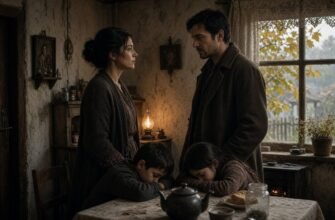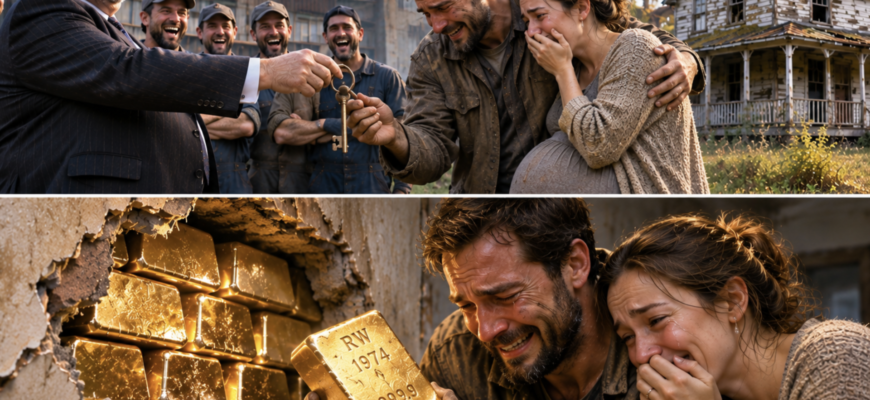
THE HOUSE BUILT WITH $87 MILLION IN GOLD — AND THE POOR FAMILY WHO DISCOVERED ITS SECRET
They thought they had inherited a worthless, abandoned house. What they found behind its crumbling walls would change their lives forever.
In 1974, in a forgotten corner of rural West Virginia, a mysterious billionaire named Richard Whitmore made a decision that no one would understand for more than fifty years.
Richard owned steel factories, coal mines, and properties across America. His fortune was enormous, but he trusted almost no one.
He had witnessed business partners betray each other, families destroy themselves over inheritance, and powerful men lose everything overnight.
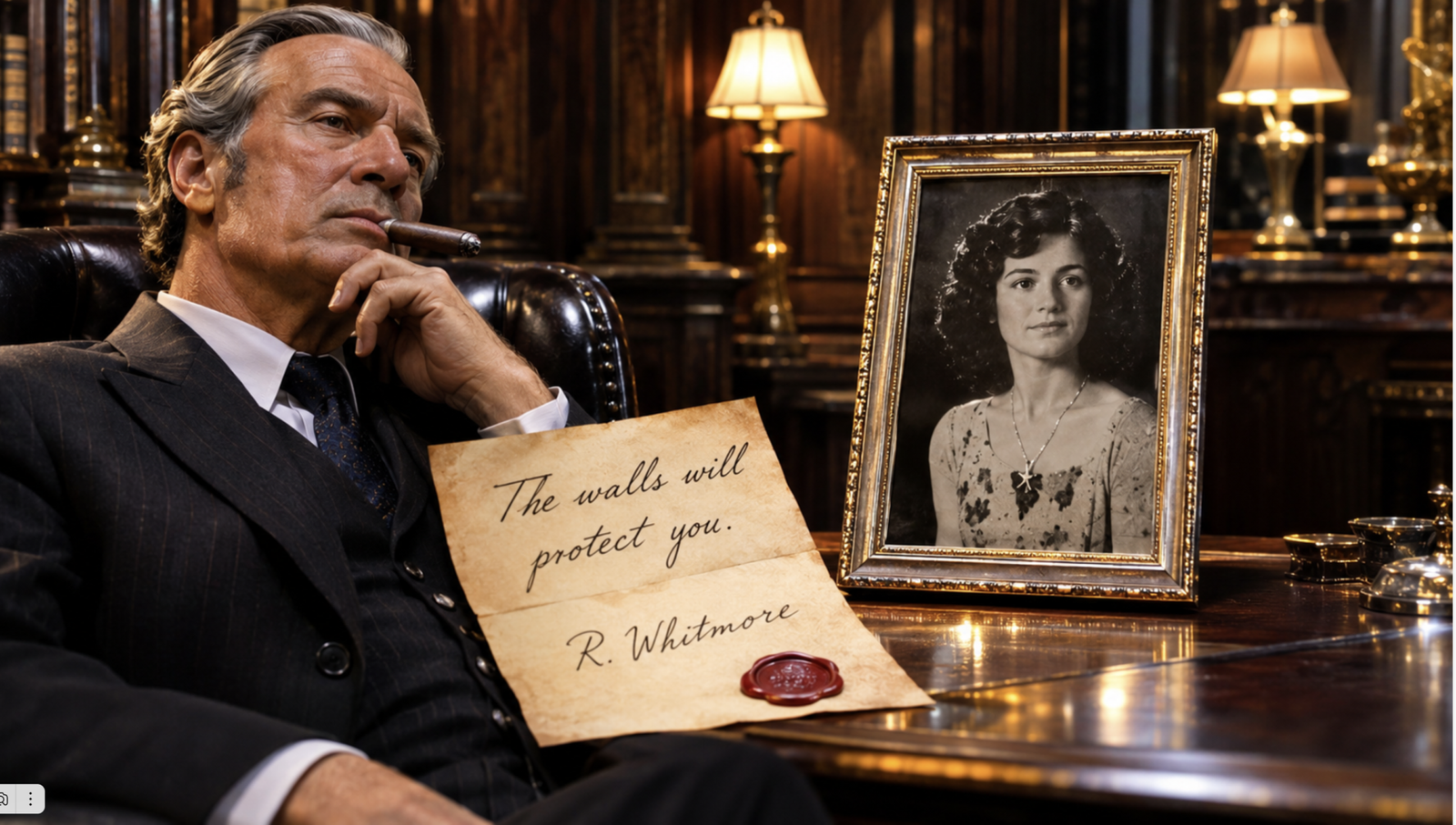
So he came up with an extraordinary plan.
On a remote piece of land surrounded by dense forests, Richard built a modest two-story farmhouse.
From the outside, it looked completely ordinary.
But its walls held a secret.
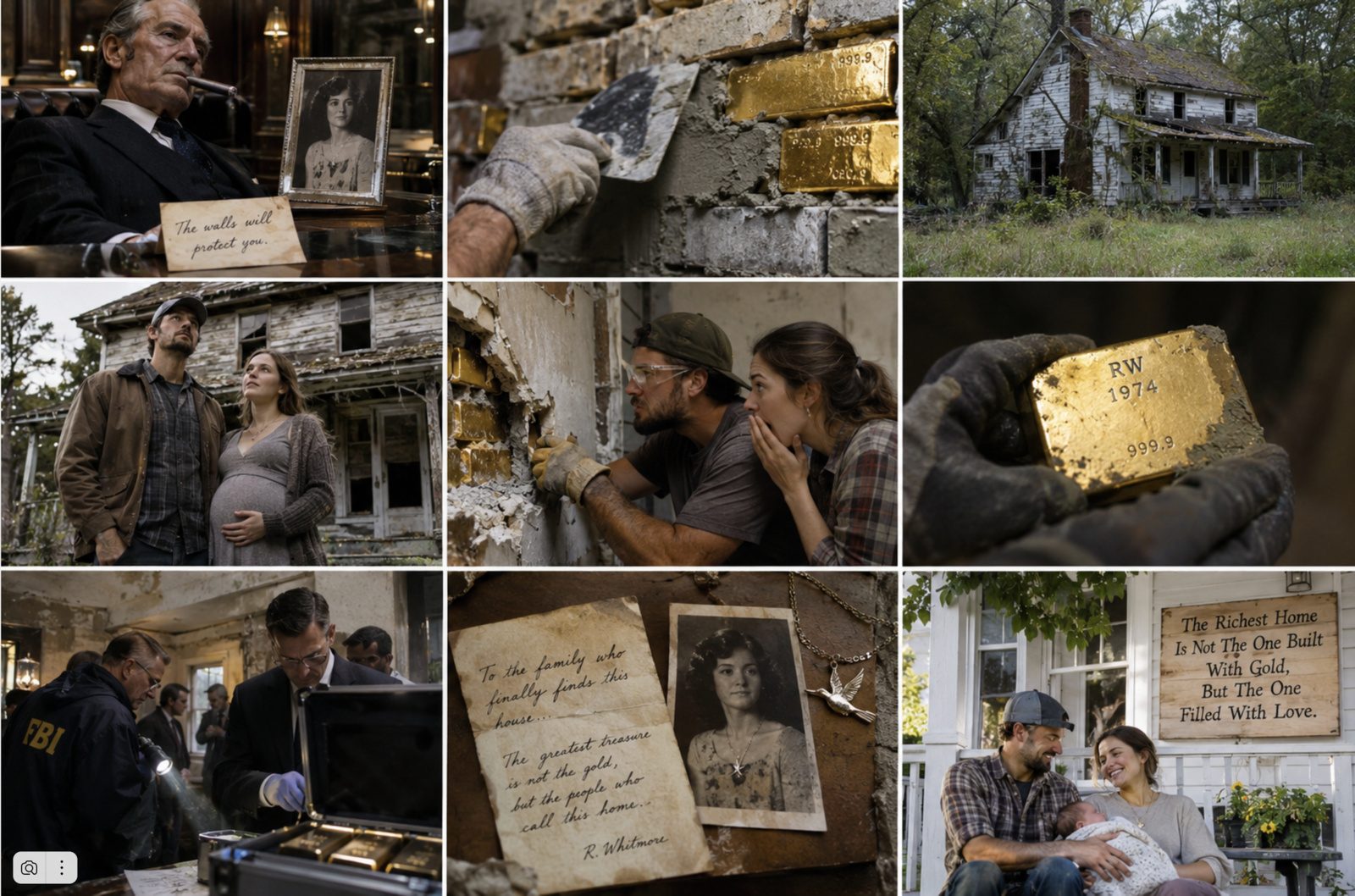
Richard had secretly purchased hundreds of solid gold bars. Each one was carefully coated in a thick layer of cement, making it look like an ordinary construction brick.
Then, using a small crew of workers who had no idea what they were handling, he built the house with those disguised gold bricks hidden inside its walls.
The workers believed they were using unusually heavy building materials.
Only Richard knew the truth.
The walls of that little farmhouse contained a fortune worth tens of millions of dollars.
But why would one of America’s richest men hide his wealth inside an ordinary house?
The answer was far darker than anyone could imagine.
CHAPTER 1 — THE BILLIONAIRE WHO VANISHED
Richard Whitmore had one daughter, Eleanor.
She was the only person he truly loved.
In 1976, Eleanor discovered that her father’s business empire was involved in a bitter legal battle. Several executives were secretly trying to take control of his fortune.
Richard feared that his enemies would eventually come after his family.
He transferred the farmhouse into a private trust and left Eleanor a mysterious letter.
It contained only three sentences:
“Never judge a house by its appearance.
The greatest treasures are often hidden where no one thinks to look.
And remember, my darling, the walls will protect you.”
Three weeks later, Richard disappeared.
His abandoned car was found near a mountain road.
No body was ever recovered.
His lawyers claimed that most of his fortune had vanished through failed investments.
Eleanor spent years searching for answers.
Eventually, she moved away, married, and disappeared from public records.
The farmhouse was forgotten.
Decades passed.
Its windows shattered. Its roof began leaking. Weeds swallowed the porch.
Nobody wanted it.
Nobody even knew who had built it.
And the secret behind its walls remained untouched.
Until 2026.
CHAPTER 2 — THE FAMILY WITH NOTHING LEFT
Thirty-two-year-old Daniel Carter worked at a struggling manufacturing plant in a small West Virginia town.
He earned barely enough to support himself and his pregnant wife, Emily.
They had been married for five years.
Emily was seven months pregnant with their first child.
Their landlord had recently increased the rent, and Daniel’s factory had reduced employee hours.
Every month became a battle to survive.
One cold November morning, the factory manager gathered the workers.
The company had acquired several abandoned properties through an old land settlement.
Instead of selling them, management decided to transfer the houses to employees who needed housing assistance.
Most of the properties were in terrible condition.
Some had collapsed roofs. Others had no running water or electricity.
When Daniel’s name was called, he received a faded envelope containing a rusty key and a property deed.
The address was 17 Willow Creek Road.
His coworkers laughed when they heard which house he had received.
“That place is practically falling apart,” one man said.
“You’d be better off living in your truck.”
Daniel said nothing.
That evening, he drove Emily to see the property.
The house stood alone at the end of a muddy road.
Its wooden porch was broken. The windows were covered with dust. Rusted pipes hung beneath the kitchen sink.
Inside, the floors were stained black, the wallpaper was peeling, and the kitchen cabinets were filled with decades of dirt.
Emily looked around silently.
Then she placed a hand on her pregnant belly.
“Daniel,” she whispered, “this isn’t much.”
“I know.”
“But it’s ours.”
Daniel looked at his wife.
For the first time in months, he felt something he had almost forgotten.
Hope.
CHAPTER 3 — THE $600 RENOVATION
They had only $600 left in savings.
Daniel borrowed tools from coworkers, collected discarded lumber, and watched free renovation tutorials online.
Emily cleaned the rooms while Daniel repaired the roof.
They removed broken furniture, scrubbed the floors, replaced damaged boards, and painted the kitchen cabinets white.
For weeks, Daniel worked at the factory during the day and repaired the house late into the evening.
His hands were exhausted.
His clothes were constantly covered in dust.
But every night, Emily reminded him:
“One day, our baby will run through these rooms.”
Slowly, the house began to change.
The kitchen became bright and welcoming.
The floors were clean.
The bedrooms had fresh paint.
And for the first time in decades, warm light shone through the farmhouse windows.
There was only one problem.
The living room wall.
A long crack ran from the ceiling almost to the floor.
Daniel decided to remove the damaged plaster and repair the masonry beneath it.
That decision changed everything.
CHAPTER 4 — THE BRICK THAT SHOULDN’T EXIST
On a rainy Saturday afternoon, Daniel was carefully removing loose plaster when a small piece of cement broke away from one of the exposed bricks.
Something underneath reflected the light.
He stopped.
At first, he thought it was copper.
He brushed away the dust.
The surface was bright yellow.
Strangely bright.
Daniel called Emily.
“Come look at this.”
She entered the room carrying two mugs of tea.
“What is it?”
“I have no idea.”
They examined the strange brick.
It was unusually heavy.
Daniel noticed a tiny marking beneath the cement.
RW — 1974
The initials meant nothing to him.
He took photographs and sent them to a local antique dealer.
The dealer called him twenty minutes later.
“Where did you find this?”
“In my wall.”
There was a long silence.
“Don’t remove anything else,” the dealer said.
“Why?”
“Because I think you may have something extremely valuable.”
The following morning, the dealer arrived with a precious-metals specialist.
They examined the exposed surface using professional testing equipment.
Then the specialist turned to Daniel.
“Sir, I need you to sit down.”
Daniel stared at him.
“What is it?”
The specialist took a breath.
“That appears to be high-purity gold.”
Emily dropped her mug.
It shattered against the floor.
Daniel looked back at the wall.
“Gold?”
The specialist nodded.
“And judging by the construction, I suspect that isn’t the only one.”
CHAPTER 5 — THE $87 MILLION SECRET
Within days, a team of engineers, legal advisers, and precious-metals experts began examining the property.
They used non-destructive scanning equipment to investigate the walls without damaging the structure.
The results were astonishing.
Dozens of unusually dense objects appeared throughout the house.
Behind the living room plaster.
Inside the kitchen walls.
Around the old fireplace.
Even beneath a sealed section of the staircase.
After carefully examining the accessible materials, the experts reached an extraordinary preliminary conclusion.
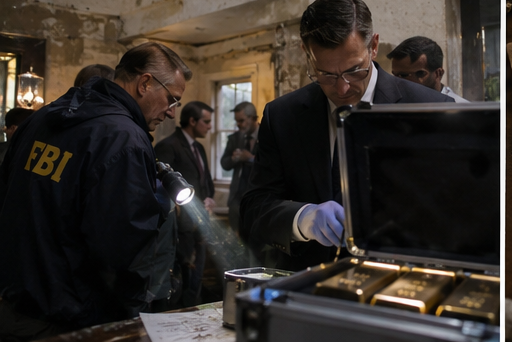
The house contained hundreds of gold bars hidden inside cement-coated masonry.
At contemporary gold prices, the estimated value could exceed $87 million.
Daniel couldn’t speak.
Emily began crying.
They had spent months worrying about rent, groceries, and hospital bills.
Now they were standing inside a house that might be worth more than they could earn in a thousand lifetimes.
But their happiness lasted only forty-eight hours.
Because someone else had been waiting for this discovery.
CHAPTER 6 — THE MAN IN THE BLACK CAR
Two nights later, a black luxury sedan appeared outside the farmhouse.
A tall man in an expensive coat stepped onto the porch.
He introduced himself as Charles Bennett.
He claimed to represent the descendants of Richard Whitmore.
“The property contains assets that belong to my clients,” he told Daniel.
Daniel showed him the deed.
“This house was legally transferred to us.”
Bennett smiled coldly.
“The house, perhaps. But not necessarily everything hidden inside it.”
He offered Daniel $250,000 to sign away any claim to the gold.
Daniel refused.
The following morning, the offer increased to $1 million.
Then $5 million.
Emily became frightened.
“Why is he so desperate?” she asked.
Daniel didn’t know.
That evening, while searching through old property records, Emily discovered something strange.
Richard Whitmore had never listed Charles Bennett’s family as heirs.
In fact, the Bennett family had been involved in the legal battle that preceded Richard’s disappearance.
And there was something even more disturbing.
Charles Bennett’s grandfather had been the last person officially recorded meeting Richard Whitmore before he vanished.
CHAPTER 7 — THE LETTER BEHIND THE FIREPLACE
During a structural inspection, engineers discovered a small metal compartment behind the fireplace.
Inside was a sealed leather case.
The case contained photographs, old financial records, and a handwritten letter dated December 12, 1976.
The letter began:
“To the family who finally finds this house…”
Daniel read it aloud.
Richard explained that he had hidden his gold after discovering that several business partners were attempting to steal his company.
He believed that some of them had also arranged threats against his daughter.
The gold was not intended for the executives, the banks, or the men who had betrayed him.
It was meant to secure his daughter’s future.
But the final paragraph was the most shocking.
“If Eleanor never returns, let this house become a blessing to someone who understands the value of an honest home. My greatest fear is that wealth will fall into the hands of those who have forgotten what it means to be human.”
Beneath the letter was a faded photograph.
It showed Richard standing beside a young woman.
On the back, someone had written:
“Eleanor Whitmore, age 19.”
Emily stared at the photograph.
The young woman looked strangely familiar.
Then she noticed the necklace around Eleanor’s neck.
A tiny silver bird.
Emily slowly reached beneath her sweater.
She was wearing an almost identical necklace.
It had belonged to her grandmother.
CHAPTER 8 — THE SECRET IN EMILY’S FAMILY
Emily had grown up hearing stories about her grandmother, a quiet woman named Nora who had moved across several states and rarely discussed her childhood.
Nora had died when Emily was twelve.
Before her death, she had given Emily the silver bird necklace and told her:
“Never forget where you came from, even if the world forgets your name.”
Emily had never understood those words.
Now, for the first time, she wondered whether her grandmother had been hiding something.
With help from a genealogist, Daniel and Emily began tracing old marriage records, birth certificates, and family photographs.
After several days, they uncovered a startling connection.
Nora’s original name had been Eleanor Whitmore.
She had changed her identity after her father’s disappearance.
Emily was Richard Whitmore’s great-granddaughter.
The discovery left everyone speechless.
The abandoned farmhouse had not simply been given to a struggling family.
Through an extraordinary chain of events, the home had returned to the billionaire’s own family.
But there was one final secret.
And it was hidden beneath the house.
CHAPTER 9 — THE ROOM THAT WASN’T ON THE BLUEPRINTS
While reviewing the original construction plans, an engineer noticed a discrepancy.
The basement was smaller than the house’s foundation should have allowed.
Behind a concrete partition was an unrecorded room.
Inside, the investigators found a heavy metal safe, a collection of documents, and a reel of old film.
The safe contained a second letter.
This one was addressed directly to Eleanor.
Richard had written that he feared his disappearance was being planned by people inside his company.
He had preserved documents that he believed could expose financial fraud and the people responsible.
The old film showed Richard speaking directly into a camera.
His voice was calm.
“If you are watching this, then the truth has finally found its way home.”
He explained that the gold had been hidden to keep it beyond the reach of his enemies while he gathered evidence against them.
Then he said something nobody expected.
“Money can disappear. Names can be erased. But the truth has a way of surviving.”
The documents were turned over to investigators.
The historical allegations reopened questions about Richard’s disappearance, although decades had passed and many of the people involved were no longer alive.
Charles Bennett’s claim to the property was challenged.
And after months of legal proceedings, the Carters received the news they had been praying for.
The ownership dispute had been resolved in their favor, and the recovered gold was legally theirs.
CHAPTER 10 — THE BABY BORN IN THE GOLDEN HOUSE
Three months later, Emily gave birth to a healthy baby girl.
They named her Eleanor.
Daniel and Emily could have abandoned the farmhouse and moved into a mansion.
They could have purchased luxury cars, private jets, and properties across the world.
Instead, they made a surprising decision.
They restored the farmhouse completely.
They preserved a small section of the original wall behind protective glass, showing one of the cement-covered gold bars exactly as it had been discovered.
The rest of the recovered gold was secured, documented, and managed with professional financial and legal guidance.
Daniel left his factory job, but he never forgot the people who had helped him when he had nothing.
The couple established a housing foundation to help struggling families repair abandoned homes across rural America.
Their first project was in the same town where Daniel had once worried about paying rent.
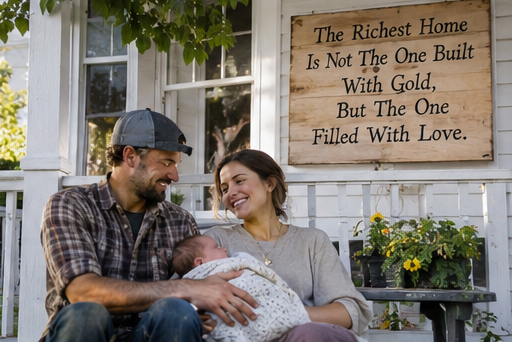
On the farmhouse porch, they placed a wooden sign.
It read:
“THE RICHEST HOME IS NOT THE ONE BUILT WITH GOLD, BUT THE ONE FILLED WITH LOVE.”
Years later, when little Eleanor was old enough to understand, she asked her father:
“Daddy, were we always rich?”
Daniel looked at the house.
He remembered the broken windows, the dirty floors, and the nights when he had wondered how they would survive.
Then he answered:
“No, sweetheart. When we moved here, we had almost nothing.”
“But the house was full of gold, wasn’t it?”
“Yes.”
“Then why didn’t you know?”
Daniel looked at Emily.
“Because sometimes the greatest treasures are hidden behind the things everyone else has given up on.”
That evening, as the sun disappeared behind the West Virginia mountains, the family sat together on the same porch that had once been falling apart.
And somewhere inside the restored farmhouse, behind a carefully preserved piece of old cement, one final gold bar remained.
Not because they needed the money.
But because they wanted future generations to remember how it all began.
But one mystery was never solved.
Richard Whitmore’s body was never found.
And inside the metal safe, investigators had discovered a final photograph taken in 1981 — five years after his supposed disappearance.
It showed an elderly man standing beside a small cabin in Alaska.
On the back were four handwritten words:
“I finally found peace.”
Was Richard Whitmore alive all those years?
Had he deliberately vanished to protect his daughter?
Or had someone else left the photograph to make the world believe he survived?
Nobody ever discovered the truth.
And perhaps that was exactly how Richard wanted it.
THE END.
This is an original fictional story, not a verified real-life event.