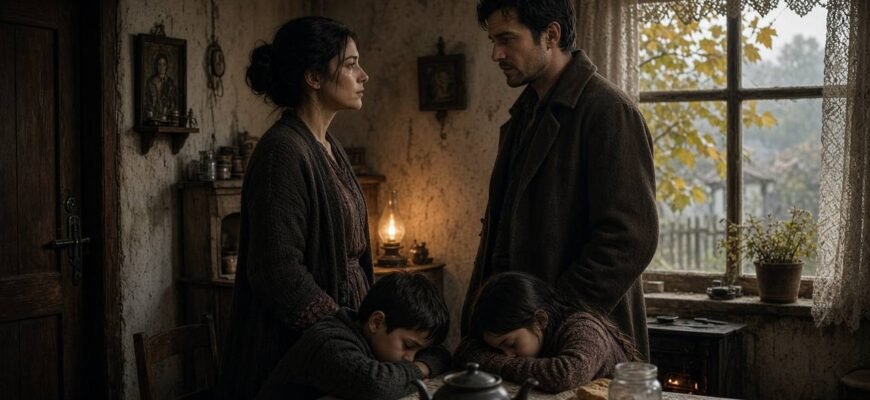
Autumn entered the village slowly, like a man who does not want to disturb the house. Fog settled on the roofs, and in Anahit’s yard the apple tree had already turned yellow, as if it too had grown tired of waiting.
Five years had passed since the day they lowered her husband’s coffin into the earth. For five years Anahit had been raising two children—a boy and a girl—who still sometimes asked at night when their father was coming home. She no longer answered. She only pressed their shoulders and put out the lamp.
The men of the village had not forgotten her.
They came with different faces. One was a neighbor who said “the wall is falling.” One was a widower who brought honey and said “it’s for the children.” One was bolder, standing under the window in the evening and whispering her name. Anahit shut the door on all of them with the same hand she used by day to bake bread. But with every closed door something inside her broke. Not from desire—from the way the world kept reminding her that she was still a woman, still alone, still someone who could be taken.
One night the boy lay feverish, and someone knocked again. Anahit opened the door ready to send the visitor away.
But Armen was standing on the threshold.
He was the same, and no longer the same. That quiet boy from school who used to watch her from the back bench as if he were afraid to breathe. The boy she had never taken seriously, because she was already in love with someone else—louder, more certain, more “like a man.” Armen had spoken only once. In the schoolyard, under autumn leaves, he had said:
“If one day you are left alone… I will come.”
Anahit had laughed. At the time it had seemed a childish promise.
Now that promise was standing at her door in a wet coat, with tired eyes.
“Your child is sick,” Armen said. “I heard it from the neighbor. I brought medicine.”
He did not step inside until Anahit herself moved aside. It was a small thing, but to her it was large. The other men of the village entered as if the house already belonged to them. Armen waited for permission.
That night he stayed in the kitchen. He boiled water, gave the medicine, sat on a chair and was silent. Anahit watched his hands—rough from work, yet careful—as they rested on the child’s forehead as if afraid to do harm. When the boy fell asleep, Armen stood to leave.
“Stay,” Anahit said suddenly, surprising even herself. “It’s raining.”
It was not raining. But she had already said it.
They sat across from each other. The lamp flickered. Somewhere on the other side of the wall the children breathed with heavy, innocent breath. Armen was silent for a long time, then said what he had carried inside himself for years.
“I loved you at a time when you still did not know what loneliness was. I loved you in a way that would not get in your way. Then I left, so I would not have to watch you become another man’s wife. And now I have come not because you are a widow. I have come because I am still standing in the same place.”
Anahit’s throat tightened. She wanted to say: you are late. She wanted to say: I am no longer that girl. She wanted to say: if I let you near, tomorrow the village will start talking, the children will hear, and I will lose someone again. Instead she only said:
“You don’t know what it means to love a man and then give him to the earth.”
Armen bowed his head.
“I know what it means to love a woman and watch her choose someone else. For years. Every day.”
The silence was so thick they could hear the fire cracking in the hearth. Anahit stood and went to the window. Outside the village was asleep, but she could feel all the eyes that would, at dawn, count how long Armen’s boots had remained on her threshold.
“If you stay,” she whispered, “I am afraid of loving you. And if you leave, I am afraid that this time I will be left alone for good.”
Armen came up behind her. He did not touch her. He only stood close enough that she felt his breath in her hair.
“I am not asking you to choose me tonight.
I am only asking that, before you send me away, you look at me once the way you looked at the man you loved.”
Anahit turned.
In that gaze there was no longer the shyness of a schoolboy. There was a man who had waited longer than love had any right to wait. And there were her own years—full of longing, pride, and fear.
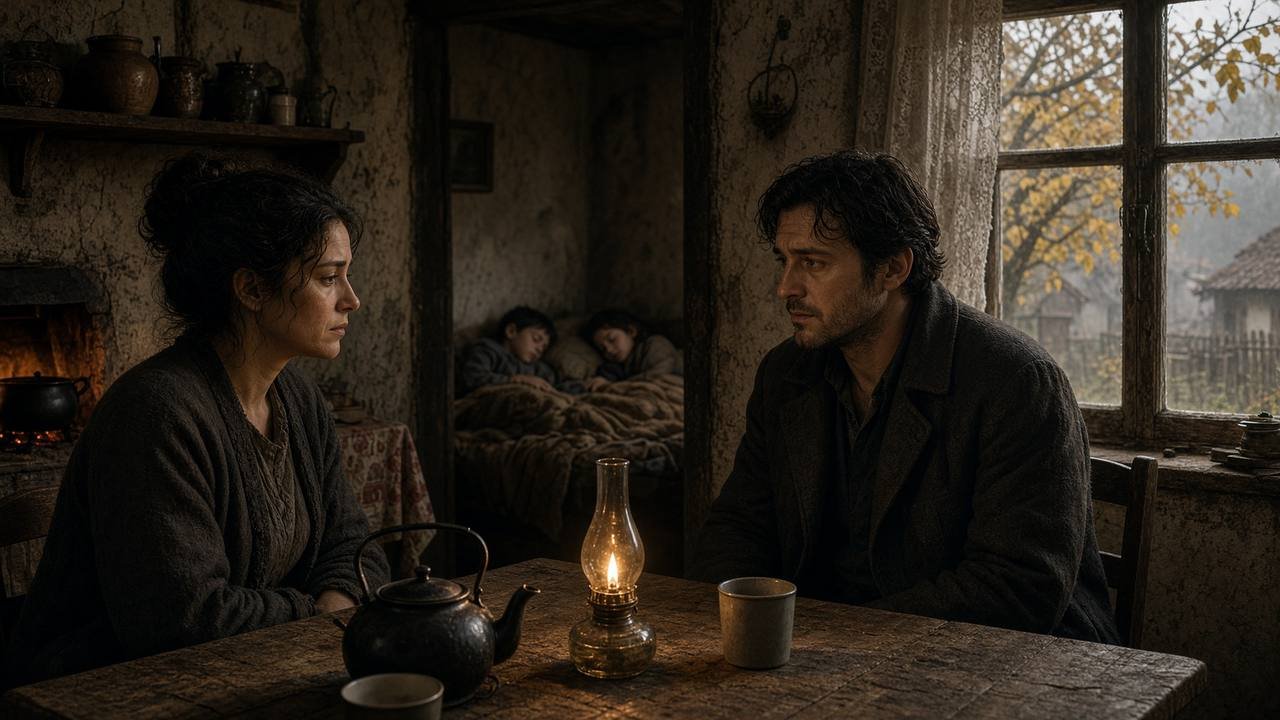
She placed her hand on Armen’s chest. Not to invite him, but to make sure this was real, warm, alive. His heart was beating fast, the way it had in the classroom when she accidentally brushed his shoulder.
“Don’t go tonight,” she said, almost without a voice. “But don’t ask me for more than I can give.”
Armen rested his forehead against hers.
“I have spent years learning how to ask for very little.”
In the morning the village saw his horse still tied to Anahit’s fence. The talk began before sunrise. But that day Anahit opened the door not to drive someone away, but to let air into the house. The children sat at the table, and Armen quietly poured tea into a third cup.
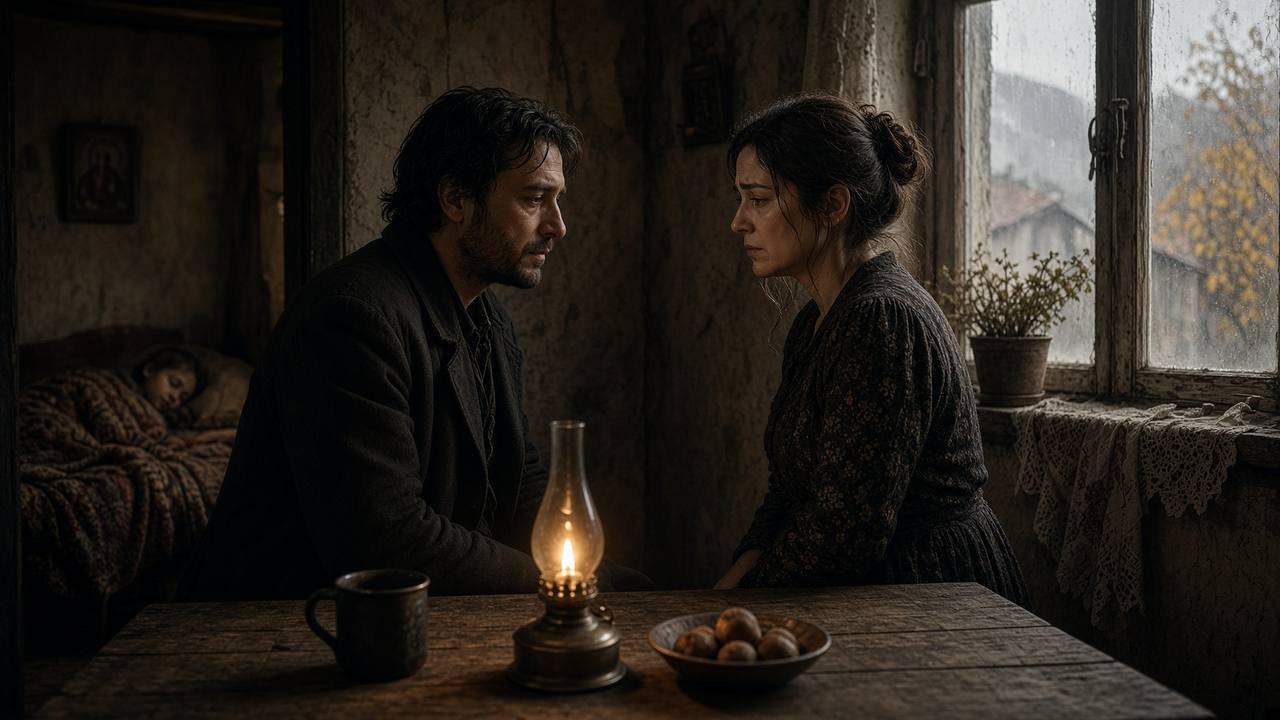
Anahit knew this was not yet love. It was only the moment when a woman who had said “no” for years did not, for the first time, say it all the way to the end.
And in a drama, sometimes that is the beginning. Not the kiss. Not the promise. But the silence in which two people finally stand facing each other—without running away.