We were a wonderful family.
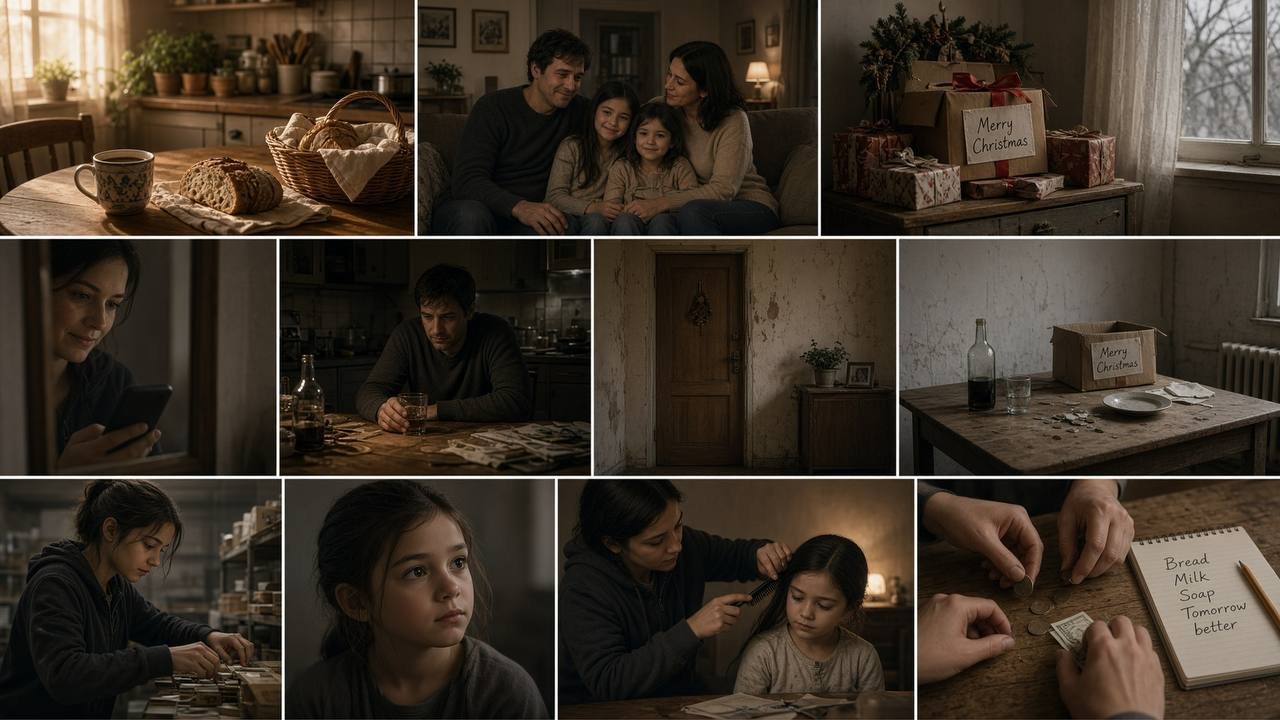
In the mornings, the house smelled of coffee and fresh bread. In the evenings, it smelled of clean floors and my mother’s perfume. My father came home from work tired, but he could still manage a smile.
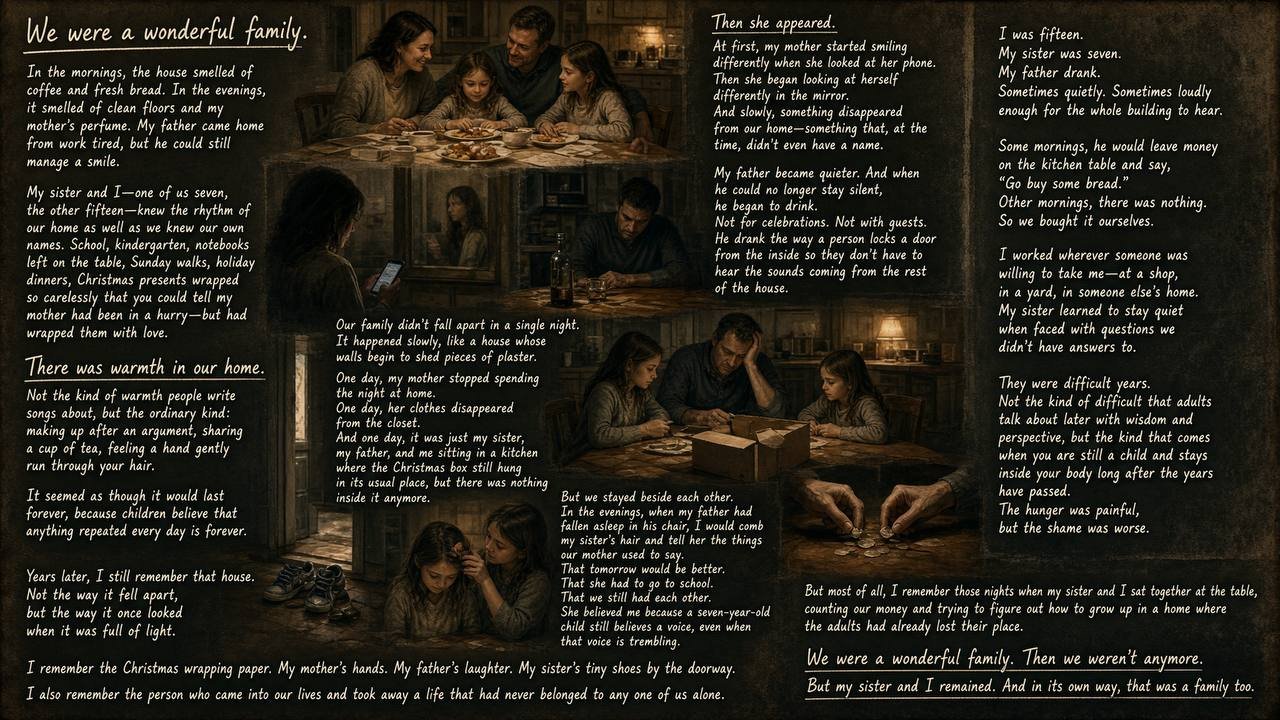
My sister and I—one of us seven, the other fifteen—knew the rhythm of our home as well as we knew our own names. School, kindergarten, notebooks left on the table, Sunday walks, holiday dinners, Christmas presents wrapped so carelessly that you could tell my mother had been in a hurry—but had wrapped them with love.
There was warmth in our home.
Not the kind of warmth people write songs about, but the ordinary kind: making up after an argument, sharing a cup of tea, feeling a hand gently run through your hair.
It seemed as though it would last forever, because children believe that anything repeated every day is forever.
Then she appeared.
At first, my mother started smiling differently when she looked at her phone. Then she began looking at herself differently in the mirror.
And slowly, something disappeared from our home—something that, at the time, didn’t even have a name.
My father became quieter. And when he could no longer stay silent, he began to drink.
Not for celebrations. Not with guests.
He drank the way a person locks a door from the inside so they don’t have to hear the sounds coming from the rest of the house.
Our family didn’t fall apart in a single night.
It happened slowly, like a house whose walls begin to shed pieces of plaster.
One day, my mother stopped spending the night at home.
One day, her clothes disappeared from the closet.
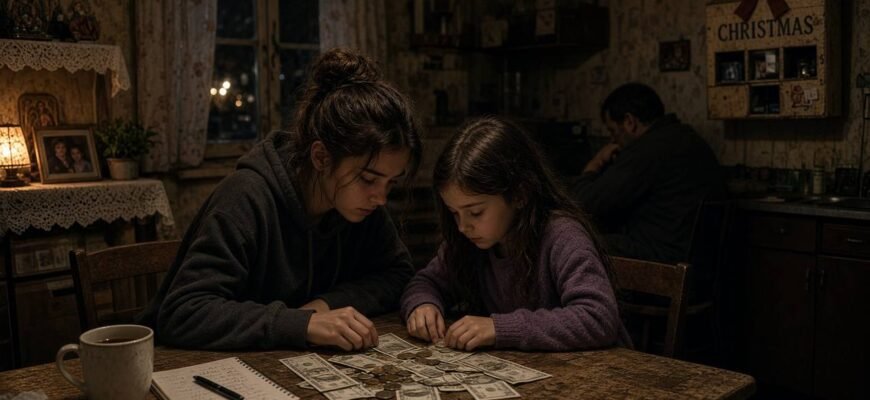
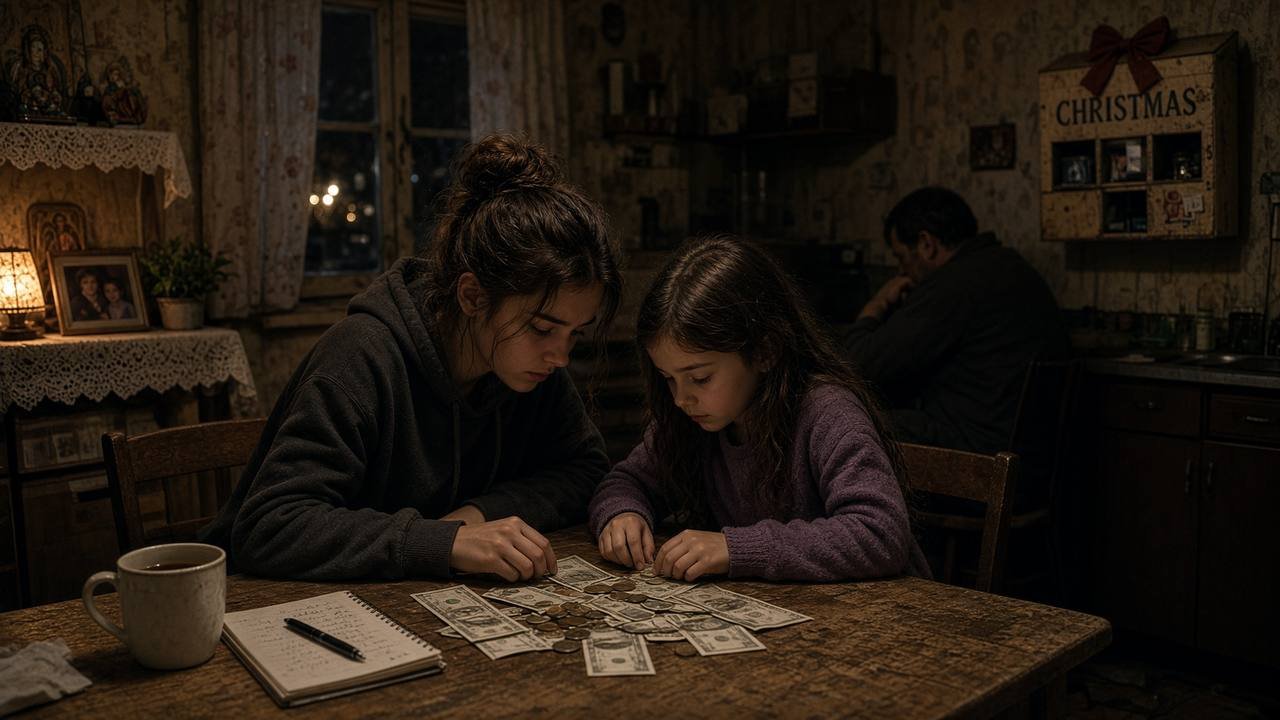
And one day, it was just my sister, my father, and me sitting in a kitchen where the Christmas box still hung in its usual place, but there was nothing inside it anymore.
I was fifteen.
My sister was seven.
My father drank.
Sometimes quietly. Sometimes loudly enough for the whole building to hear.
Some mornings, he would leave money on the kitchen table and say, “Go buy some bread.”
Other mornings, there was nothing.
So we bought it ourselves.
I worked wherever someone was willing to take me—at a shop, in a yard, in someone else’s home.
My sister learned to stay quiet when faced with questions we didn’t have answers to.
They were difficult years.
Not the kind of difficult that adults talk about later with wisdom and perspective, but the kind that comes when you are still a child and stays inside your body long after the years have passed.
The hunger was painful, but the shame was worse.
The shame that your mother had left with someone else.
The shame that your father could no longer be the father he was supposed to be.
The shame of earning your own money while the neighbors looked at you as though they already knew your entire story.
But we stayed beside each other.
In the evenings, when my father had fallen asleep in his chair, I would comb my sister’s hair and tell her the things our mother used to say.
That tomorrow would be better.
That she had to go to school.
That we still had each other.
She believed me because a seven-year-old child still believes a voice, even when that voice is trembling.
Years later, I still remember that house.
Not the way it fell apart, but the way it once looked when it was full of light.
I remember the Christmas wrapping paper.
My mother’s hands.
My father’s laughter.
My sister’s tiny shoes by the doorway.
I also remember the person who came into our lives and took away a life that had never belonged to any one of us alone.
But most of all, I remember those nights when my sister and I sat together at the table, counting our money and trying to figure out how to grow up in a home where the adults had already lost their place.
We were a wonderful family.
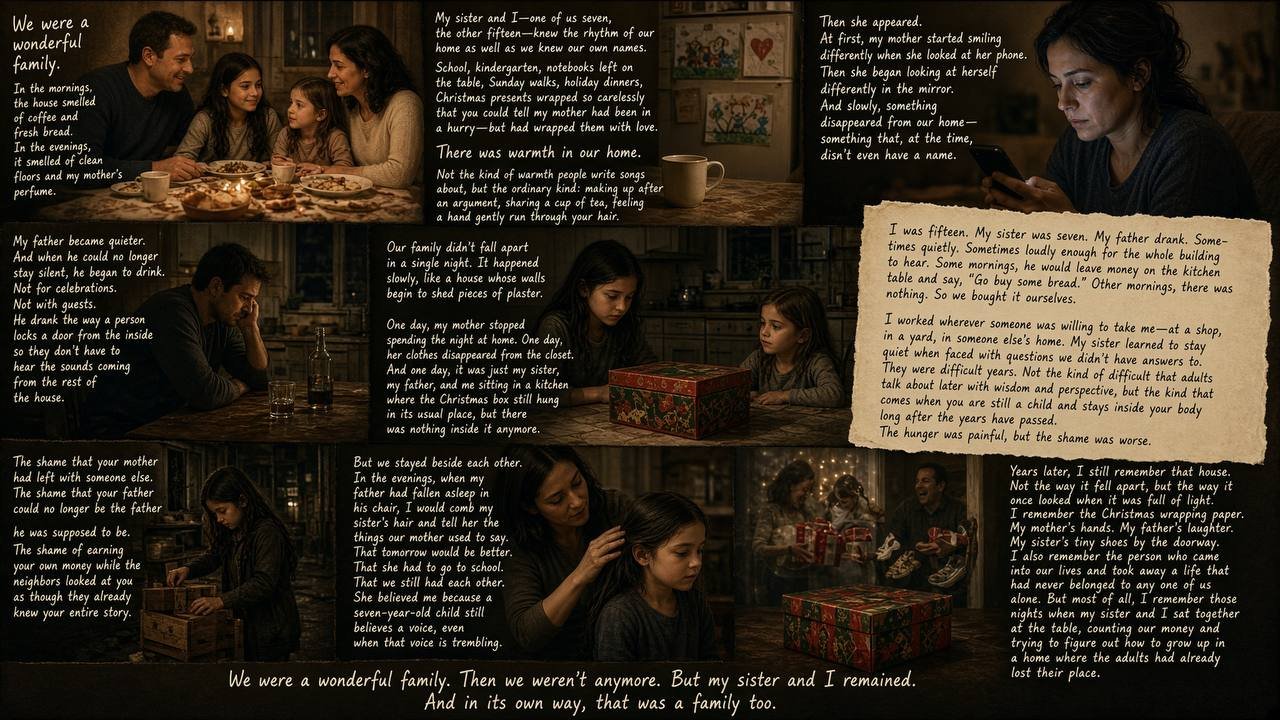
Then we weren’t anymore.
But my sister and I remained.
And in its own way, that was a family too.